
From a Simple Shop House to Building a National Culinary Business
When hearing the name Solaria, what probably comes to mind is fried rice, kwetiau, capcay, or a restaurant easily found in shopping malls and various cities across Indonesia. However, behind such a well-known brand lies a business journey that started from a modest venture.
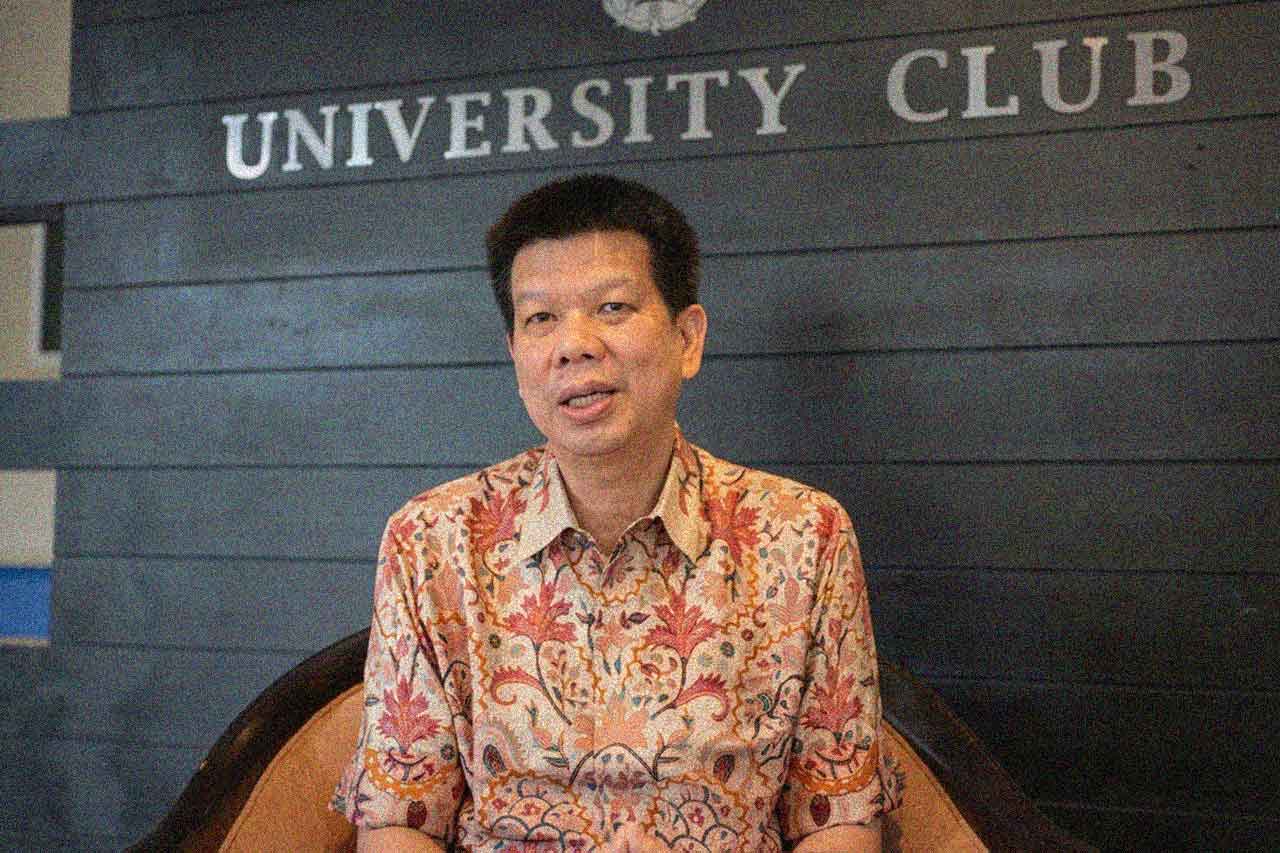
The founder of Solaria is Aliuyanto, an alumnus of the Faculty of Economics at Universitas Gadjah Mada (UGM), class of 1985. Before becoming a restaurateur, Aliuyanto worked for five years at a private company. Feeling that his job no longer offered challenges to develop his potential, he decided to resign and try building his own business.
Interestingly, the culinary business was not something that was Aliuyanto’s passion from the start. In fact, he once stated that cooking was not his hobby. The choice to enter the culinary business was mostly a result of the journey and opportunities that came later.
In 1991, his first restaurant began operating. The business was not an instant success. According to Aliuyanto’s story published by UGM, Solaria only began gaining recognition around 1995. In the early days, he only employed four staff members. Years later, that business grew into a restaurant chain with hundreds of outlets and thousands of employees.
That story is interesting not only because Solaria managed to become a major culinary brand. There are several principles from Aliuyanto’s journey that are relevant to anyone building a business, including MSME owners and website-based businesses.
If your business wants to implement a consumer psychology-based marketing strategy, the foundation begins with a fast, SEO-friendly website capable of converting visitors into customers. SIMPLIFY is ready to help build a professional website that supports the growth of your digital business.
Or save SIMPLIFY’s number for your future business digital needs here.
Daring to Start Even When Capital Isn’t Ideal
One of the most interesting parts of Aliuyanto’s story is the condition under which he first started his business.
After working for five years, his savings were not yet sufficient to meet his business capital requirements. However, that condition did not cause him to cancel his plans to become an entrepreneur. He still started the business with the resources available.
This provides an important lesson: starting a business doesn’t always mean waiting for every condition to be perfect.
Many prospective entrepreneurs spend too long in the preparation stage. Waiting for larger capital, waiting for the logo to be finished, waiting for the perfect website, waiting for social media to gain many followers, or waiting for the product to be truly flawless.
In reality, in business, many things can only be discovered after the product actually meets consumers.
This does not mean that capital and planning are unimportant. Both are still necessary. However, the scale of the business in its initial stage should be adapted to the available capabilities.
If capital is limited, the business can be started on a small scale. If manpower is limited, the number of products or services can be restricted. If you don’t have many customers yet, the first focus can be directed toward acquiring initial customers and understanding their needs.
In other words, resource constraints shouldn’t always serve as an excuse not to start.
Solaria Was Not an Instant Success
Solaria’s story also shows that large businesses usually have phases that are invisible to consumers.
Aliuyanto’s first restaurant opened in 1991, but according to UGM, the business only started becoming known in 1995. This means there was a process of several years before the brand gained wider recognition.
This is important because digital culture often makes business growth look much faster than it actually is.
We see a business when it already has thousands of customers.
We see it when its social media already has many followers.
We see it when its website is already on the first page of Google.
We see it when its branches are already located in many cities.
However, we often don’t see the years when the owner was still searching for the right product, trying to get the first customers, improving service, dealing with operational problems, and learning from mistakes.
Solaria’s journey shows that business growth is a process, not a single event.
Solving Problems with Knowledge and Capability
One principle directly shared by Aliuyanto is that obstacles in business must be solved with knowledge and capability. He also linked this principle to the education he received.
This principle is highly relevant to today’s business world.
When sales drop, don’t just say the market is slow.
Find out the cause.
Is the product less appealing?
Is the price inappropriate?
Are customers unaware of the product?
Is the website difficult to use?
Is the product page unconvincing?
Does the business fail to appear when prospective customers search on Google?
Are customers contacting via WhatsApp but not getting a prompt response?
Each of these problems requires a different approach.
This is where knowledge and data become crucial.
Modern business requires not just courage, but also the ability to read information and make decisions based on facts.
For example, online store owners can look at Google Analytics to understand visitor behavior. Google Search Console can be used to see how the website is discovered through search engines. Transaction data can be used to identify which products sell the most.
Business problems then transform from merely “slow sales” into much more specific questions:
At what point do customers stop buying?
More specific questions yield more measurable solutions.
A Brand Is More Than Just a Logo
There is another takeaway from Aliuyanto’s story that is highly relevant for today’s businesses: the importance of maintaining the brand.
In the story shared with UGM, Aliuyanto explained that when expanding a business, the brand is something that must be maintained.
This is an important lesson for MSMEs.
A brand is not just a logo.
A brand is the experience that occurs repeatedly whenever someone interacts with a business.
A memorable name is part of the brand.
The visual appearance is part of the brand.
Product quality is part of the brand.
The way you respond to customers is part of the brand.
The website is also part of the brand.
Even how a business appears on Google can influence a person’s perception of that business.
Therefore, building a brand doesn’t have to start with a large budget. Small businesses can also start by maintaining consistency in name, visual identity, communication, product quality, and customer experience.
From Four Employees to a Large-Scale Business
At the start of the journey, Aliuyanto had only four employees. Over two decades, the scale of that business changed dramatically. UGM noted that Solaria had grown to around 200 restaurants spread across 55 cities and 31 provinces when Aliuyanto shared his experience in 2016.
Those numbers demonstrate an important principle in business:
large scale is usually built on systems that have previously been tested on a small scale.
A business cannot instantly have dozens of branches with processes that are completely unproven.
The product needs to be tested.
The pricing needs to be tested.
The location needs to be tested.
The service needs to be tested.
The supply chain needs to be tested.
The record-keeping system needs to be tested.
Then, once a successful pattern is found, the process can be made more systematic and applied on a larger scale.
The same principle applies to digital businesses.
The initial website might only have a few pages. As business needs grow, new features can be added to the website. SEO can be expanded. The catalog system can be improved. WhatsApp integration can be added. A customer database can be built.
Growth doesn’t always have to happen through giant leaps.
Often, growth actually happens through small improvements made consistently.
Solaria’s Lessons for MSME Owners
Aliuyanto’s story also provides several lessons that small business owners can apply directly.
1. Start with available resources
Do not let limitations become an excuse not to experiment.
Start at a scale you are able to manage.
2. Don’t expect the business to be big right away
Solaria itself required time before becoming widely known.
A business that has only been running for a few months shouldn’t always be compared to a company that has been operating for decades.
3. Use knowledge to solve problems
When facing business problems, don’t stop at assumptions.
Gather data.
Study your customers.
Measure results.
Run experiments.
Evaluate.
Then improve.
4. Build the brand from the start
A strong brand doesn’t always require expensive design. What matters more is consistency.
The name, appearance, message, quality, service, and customer experience must support each other.
5. Prepare the business to scale
As the number of customers grows, workflows previously done manually may no longer be effective.
Therefore, business owners need to start thinking about systems.
Websites, customer records, inventory, payments, customer service, up to digital marketing can be made increasingly structured as the business grows.
What Does This Have to Do with Websites?
In the digital era, a website is no longer just an online business card.
For a business, a website can be an information hub that works 24 hours a day.
Prospective customers can find product information, read company profiles, view portfolios, find addresses, contact the business via WhatsApp, or make purchases without having to ask the business owner one by one.
However, having a website alone is not enough.
The website must be easy to find.
It must be fast.
It must be comfortable to use on smartphones.
The information must be clear.
The content must address the needs of prospective customers.
And most importantly, the website must support business goals.
This is where websites, SEO, and digital strategies become part of the business system, not just accessories.
If Solaria’s story shows how a physical business can grow from a small scale to a large one through a long process, digital business shares a similar principle: build the foundation, measure results, improve, then scale.
The Biggest Inspiration from Solaria Founder’s Story
Aliuyanto’s story may not teach that everyone should quit their job and open a restaurant.
Rather, the more relevant lesson is how one faces uncertainty when starting something new.
He started after five years of working as an employee. His capital was limited. The culinary business wasn’t even his hobby from the start. His first restaurant wasn’t instantly popular either. Yet, the business was continuously run and developed.
There is a pattern that can be drawn from that journey:
start → face obstacles → learn → improve → maintain brand → develop systems → grow.
That pattern applies far beyond the restaurant business.
It can be applied to online stores, professional services, technology companies, agencies, local businesses, as well as MSMEs.
Because in the end, business is not just about finding a good idea.
Business is about the ability to make that idea work in real life.
Closing
Today, Solaria is known as one of Indonesia’s major restaurant chains. However, that journey started from Aliuyanto’s simple decision to leave his job and try building his own business in 1991. His business wasn’t immediately famous and was initially supported by only four employees.
The most interesting aspect of that story isn’t merely the number of outlets successfully built.
What is more important is the process.
Starting when conditions aren’t perfect yet. Enduring when results are not yet visible. Solving problems with knowledge and capability. Then building a brand that can grow along with its business system.
For today’s MSME owners, the lesson is quite simple:
Not all large businesses start with large capital. But a business that wants to become large requires the willingness to keep learning, improve systems, and build something consistent.
And just like Solaria’s story, that journey usually begins with one small step that is actually taken.
Main source: Universitas Gadjah Mada, Pemilik Solaria Berbagi Pengalaman Wirausaha pada Calon Wisudawan UGM (2016).
Note: A number of media outlets cite figures around 200 outlets, 55 cities, and 31 provinces when quoting Aliuyanto/UGM statements. These figures represent the snapshot during the period when the information was shared, not the latest numbers for 2026.
Image source: YouTube Alumni Office Universitas Gadjah Mada: Pembekalan Wisudawan Program Pascasarjana Periode Januari 2016