
Loop Marketing: Why Your Website Is No Longer Just a “Showcase” at the End of the Funnel
The old way of thinking about marketing usually goes like this: grab people’s attention, collect leads, then push them until they finally buy. This funnel model has been used for years. The problem is, the way people make decisions today is much messier — they jump from one platform to another, ask AI, read reviews, and only then visit a brand. A straight, one-way funnel is no longer a good way to describe this reality.
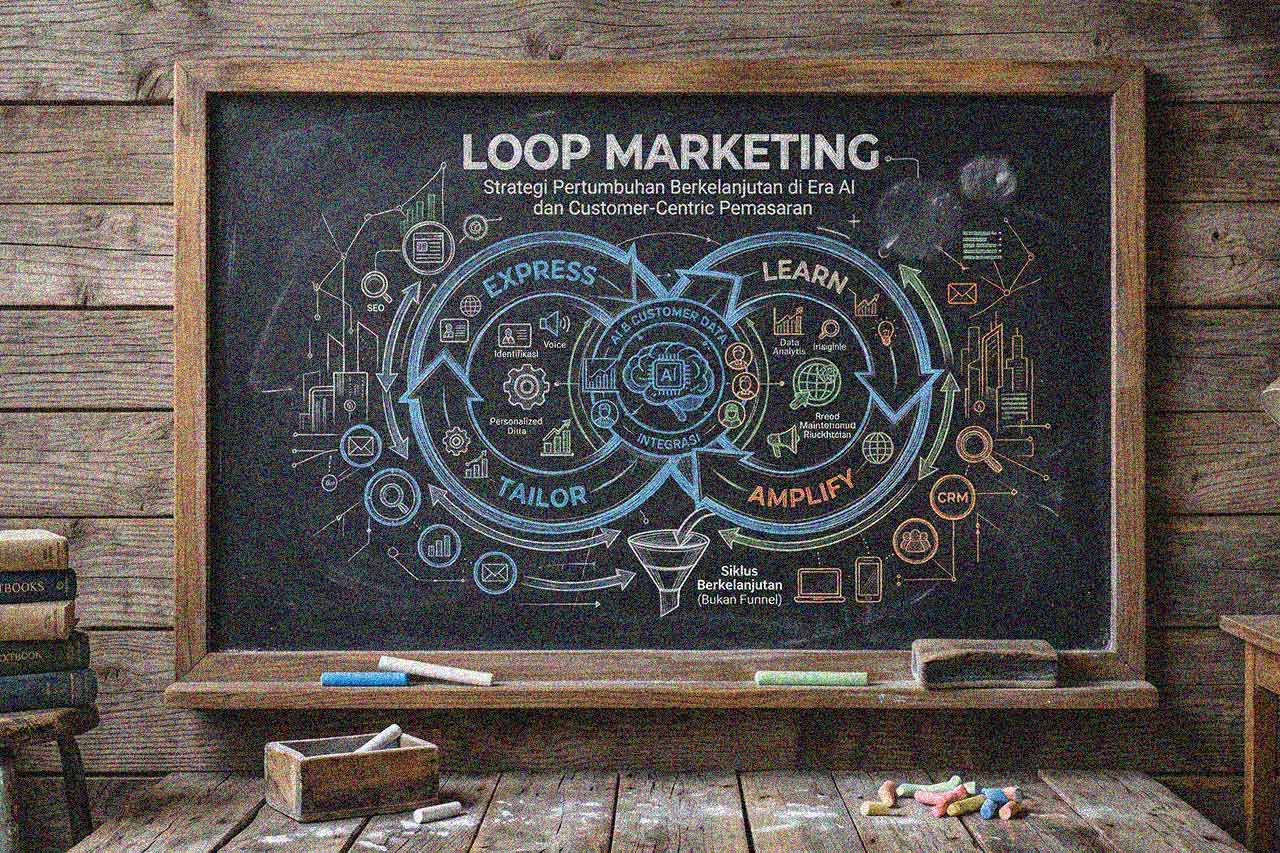
HubSpot answered this problem with a concept called Loop Marketing, introduced at the INBOUND 2025 event. The main idea: marketing doesn’t stop once someone makes a purchase. Every transaction actually fuels the next cycle, which keeps spinning and getting smarter thanks to data and AI.
If you’re thinking about building or redesigning your company website, there’s one key takeaway from this concept: a website is no longer just a “front page” placed at the end of the marketing process. It becomes the engine that drives the entire growth cycle.
In the era of Loop Marketing, a website shouldn’t stop growing once it’s launched. Ideally, it becomes a strong foundation at the Express stage, supports personalization at the Tailor stage, acts as a hub for spreading your message at the Amplify stage, and serves as a data source for the Learn stage. SIMPLIFY helps your business build a website that’s not just good to look at, but also designed as infrastructure that supports long-term growth. Let’s talk about what your website needs.
Or save SIMPLIFY’s number for your future business digital needs here.


So What Exactly Is Loop Marketing?
In short, Loop Marketing is HubSpot’s way of replacing the linear funnel mindset with a model that keeps spinning continuously. A customer who has already made a purchase isn’t the finish line — they’re the starting point of a new cycle.
Every time a customer interacts with a brand, new data and lessons are generated that can be used to sharpen the next marketing move. Ideally, the second loop is more effective than the first, the third loop is even better, and so on.
Visually, it looks something like this:
Express
↓
Tailor
↓
Amplify
↓
Learn
↶
then back to Express again, but this time with sharper insights
The process never really ends. And in the middle of all this, the website is usually where visitors land, where data starts to build up, and where personalization starts to work.
Why Did This Framework Show Up Now?
A few major shifts pushed HubSpot to create this new approach.
1. The Customer Journey Isn’t a Straight Line Anymore
People might start on Google, move to Instagram, check a marketplace, chat with an AI bot, join a webinar, or simply hear a recommendation from a friend — all of this can happen before they actually make a decision.
A pattern like this is hard to map using a funnel that assumes everyone moves through the same sequence. A website built for just one “entry point” will struggle to keep up with such a scattered pattern.
2. AI Is Changing How People Search for Information
These days, a company’s website is often no longer the first place people look for answers. Generative AI already provides answers before people even get a chance to visit the brand’s own website.
As a result, websites need to be built with content structured in a way that’s easy for machines to “read,” not just pleasant for human eyes.
3. Data Is Becoming an Increasingly Valuable Asset
Companies now have data scattered across many places: CRM, website, social media, customer service, email marketing, even mobile apps.
Loop Marketing tries to bring all these scattered pieces of data together so every marketing move becomes more accurate — and that’s only possible if the website is built with proper data integration from the start, not patched on later with some random plugin.
The Four Stages of Loop Marketing
HubSpot sums it up into four playbooks.
1. Express
This stage is about knowing your own organization’s identity.
Before diving into AI or automation, a company needs a clear foundation covering:
- Ideal Customer Profile (ICP)
- Positioning
- Value Proposition
- Brand Voice
- Messaging Framework
- AI-ready Style Guide
HubSpot stresses that AI will only produce good output if a company already has strong business context. And usually, the website is the first place where this identity gets put to the test: does the messaging, look, and information structure truly reflect who your company really is?
2. Tailor
Once the brand identity is clear, it’s time to use customer data to create a more personal experience.
Personalization here goes beyond just greeting customers by name in an email. It covers a broader scope, including:
- interaction history,
- digital behavior,
- customer preferences,
- where they are in the customer journey,
- general business context.
AI helps read these patterns so communication hits closer to the mark. A well-architected website allows content and offers to appear differently depending on who’s visiting.
3. Amplify
At this stage, the brand’s message gets spread across more channels.
The goal isn’t just chasing more impressions, but making sure your brand shows up wherever people need information.
Some of the channels commonly used:
- website,
- SEO,
- social media,
- email marketing,
- professional communities,
- AI platforms,
- public relations,
- content marketing.
The more consistent the customer experience across all these channels, the more effective the next loop becomes — and the website remains the central point that ties all these channels into one cohesive experience.
4. Learn
This is the most decisive stage in the entire Loop Marketing cycle.
All the marketing activities carried out generate data that gets used to uncover:
- which content performs best,
- which channels are most effective,
- new customer segments that haven’t been tapped yet,
- opportunities to optimize campaigns,
- shifts in customer behavior.
These findings are then used to update the strategy back at the Express stage, and the cycle starts again from a smarter point. This is where a website with proper analytics and tracking becomes the most valuable source of data.
Where AI Fits Into Loop Marketing
Loop Marketing doesn’t treat AI as a replacement for the marketing team.
Instead, AI acts as an accelerator, speeding up analysis, automation, and personalization.
Roughly, the division of roles looks like this:
| Human’s Job | AI’s Job |
|---|---|
| Setting business strategy | Analyzing data |
| Defining brand positioning | Segmenting customers |
| Leading creative direction | Personalizing content |
| Making final decisions | Generating predictions and automation |
| Validating final results | Running ongoing optimization |
So, AI speeds up the process, but strategic decisions still stay in human hands.
What You Need to Prepare Before Getting Started
Before actually running Loop Marketing, there are a few foundations an organization should ideally already have:
- a fast, well-structured website that’s ready to connect with various other systems;
- a clean, integrated CRM;
- reliable customer data;
- well-documented brand guidelines;
- a clear Ideal Customer Profile;
- a consistent content strategy;
- solid collaboration between marketing, sales, and customer success teams.
Without these foundations — including a properly structured website — AI won’t have enough context to produce recommendations that are actually useful.
What’s the Payoff of Loop Marketing?
Some benefits this approach can offer:
- quicker to respond to changes in customer behavior,
- more strategic use of AI,
- encourages a culture of continuous improvement,
- better integration of data across channels,
- more personalized customer experiences,
- stronger long-term growth through ongoing learning.
Conclusion
Loop Marketing represents a new way of thinking about marketing in the age of AI. Instead of stopping once a conversion happens, this framework pushes companies to keep spinning through a learning cycle, powered by data, personalization, and an ever-improving customer experience.
For companies that already have a solid CRM, mature customer data, a website with a strong structure, and a data-driven work culture, Loop Marketing can be a worthwhile approach to boost marketing effectiveness. But since this framework is still fairly new and comes from a single vendor, applying it should be adjusted to each organization’s own situation and continuously evaluated over time.
References
- HubSpot. Loop Marketing. https://www.hubspot.com/loop-marketing
- Aspiration Marketing. What Is the Role of Loop Marketing and Why Does It Matter? https://blog.aspiration.marketing/en/what-is-loop-marketing-and-why-does-it-matter
- Modgility. The Loop Marketing Playbook. https://www.modgility.com/blog/the-5-essential-components-of-a-loop-marketing-playbook
- The Smarketers. Loop Marketing: Everything You Need to Know. https://thesmarketers.com/blogs/loop-marketing-guide/
- New Breed Revenue. What Is Loop Marketing? https://www.newbreedrevenue.com/blog/what-is-loop-marketing