
Need a Professional Website? Or Staff to Maintain Your Website?
Bring your business, school, or organization to a more modern presence through professional website development that is responsive, secure, and aligned with your brand identity. Make sure your site is always managed and maintained optimally through our website maintenance services.
Tap the WhatsApp button below to consult directly with the SIMPLIFY team and start receiving the best service from us.
[vc_row][vc_column][vc_btn title=”WhatsApp” style=”classic” shape=”round” color=”success” align=”left” i_icon_fontawesome=”fa fa-whatsapp” css_animation=”none” add_icon=”true” link=”url:https%3A%2F%2Fwa.me%2F%2B628998706033|target:_blank”][/vc_column][/vc_row]
Or save SIMPLIFY’s number — you never know when you might need it.




Background: Bayern and Political Pressure in the Nazi Era
In the late 1930s, all sports activities in Germany were controlled by the official organization Nationalsozialistischer Reichsbund für Leibesübungen (NSRL)[1]. Many sports organizations and clubs were required to adapt to state symbolism. Bayern Munich experienced political pressure as well: the club’s president at the time, Kurt Landauer, who was of Jewish descent, was forced to resign and later detained before fleeing to Switzerland[2]. These pressures form the basis of public suspicion that the club’s visual identity may have changed under coercion.
Did Bayern Really Use a Swastika Logo?
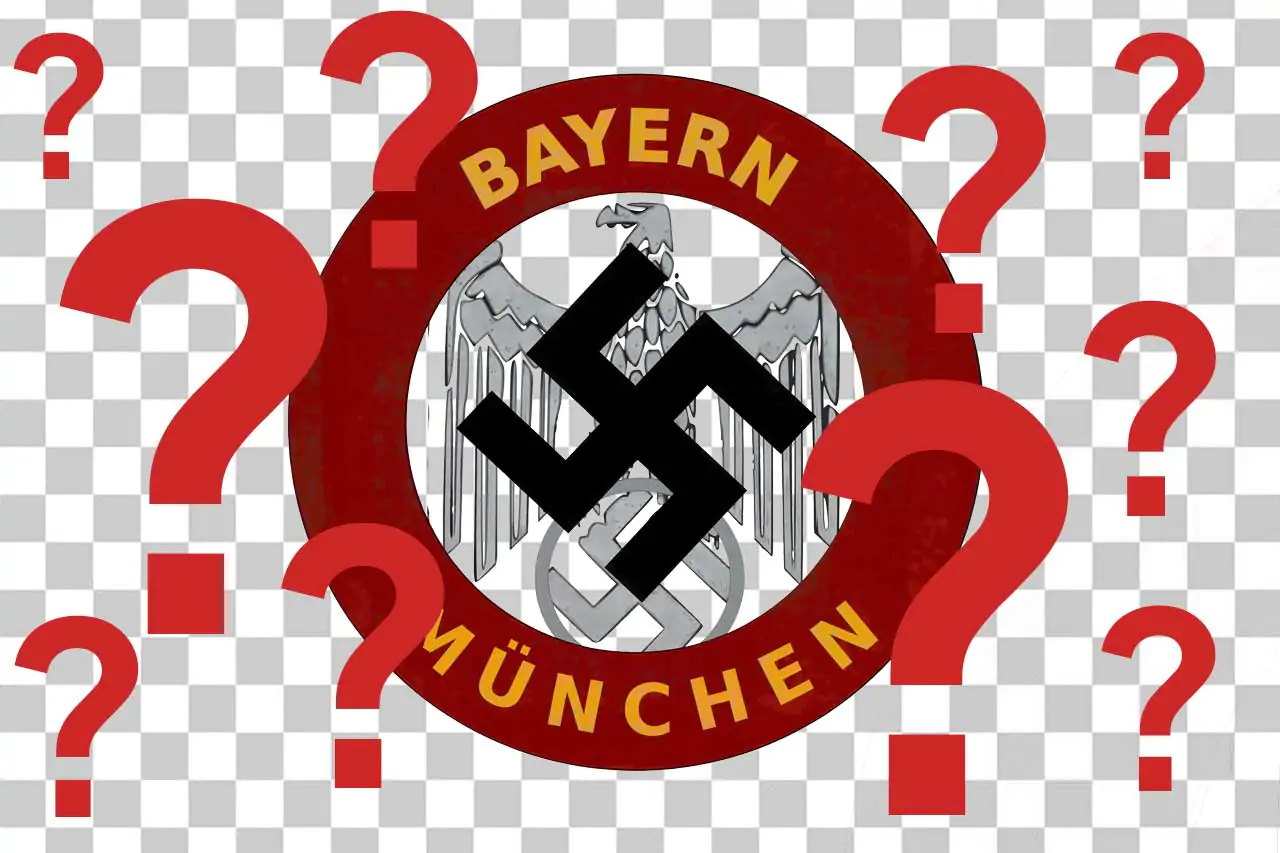
Even though many circulating images show a “1939 logo” with a swastika, archival research and logo documentation reveal several key points:
- No official evidence—documents or archival club photographs—has been found showing Bayern using a swastika-bearing logo as its official crest.[3]
- The officially published Bayern logo evolution archives do not include any design with Nazi symbols for the 1938–1945 period.[4]
- Many “1939 logo” images circulating online are likely modern reconstructions, illustrations, or misinterpretations of the NSRL emblem (a state symbol frequently seen in sports events of that era).[5]
The confusion is worsened by the fact that photographs of sports events from the Nazi era often included state emblems (eagle + swastika) on banners or uniforms — but these were different from club identity logos.
Why Has This Issue Gone Viral Again?
There are several reasons why the topic of the “Bayern Munich 1939 logo” has resurfaced:
- The need for historical transparency: Fans and researchers want the club to be more open about its past, not to glorify symbols, but for historical education.
- The spread of reconstructions on social media: Images without context easily go viral and create misunderstandings.
- Interest in the relationship between football and politics: The case of Kurt Landauer and political pressure fuels discussion on how regimes influence clubs.
Conclusion
To this day, verifiable archival evidence does not support the claim that Bayern ever used an official logo featuring a swastika. However, the debate remains relevant because it opens space to discuss how political history influences the world of sports. Recognizing and discussing the past — including its darker chapters — is an important step toward collective understanding.
References & Footnotes
- NSRL — National Socialist League of the Reich for Physical Exercise. Summary source: wikipedia.org.
- Biography of Kurt Landauer and related history in FC Bayern documentation: fcbayern.com (Landauer).
- Community discussion and analysis regarding the absence of evidence for a swastika logo: example discussion on Reddit: reddit.com.
- Summary of Bayern’s logo evolution: 1000logos.net.
- Analysis identifying several “1939 logo” images as modern reconstructions: thickaccent.com.
- Sports media discussion on whether club logo archives should include the Nazi period: footyheadlines.com.